


Q32- What is the bit rate of ISDB-T for fixed and mobile/ handheld reception ?
A- In case of ISDB-T system, it is slightly complicate to calculate bit rate because hierarchical transmission is possible.
An example of bit rate for fixed reception and mobile/ handheld reception
HD fixed reception + One-seg service in one 6MHz bandwidth
(a) HD service for fixe reception: 12segment, 64QAM, r=3/4, bitrate=16.85 Mbps
(b) One-seg service for portable reception: 1 segment, QPSK, r=2/3, bitrate=416 kbps
Q31- What is the time interleaving and how does it work for portability and mobile?
A- In general digital communication system
adopts error correction system with interleave technology. The error
correction system shows best performance in case of random error
pattern. Time interleave technology is adopted to randomize many degradation
factors, such as man-made noise, multi-path fading, interference to get
best error correction process. In this respect, time interleave technology is very effective to improve
receiving performance and it much contribute to the realization for
mobile/ portable reception and indoor fixed reception.
Q30- Is SFN, used by ISDB-T, possible for ATSC and DVB-T?
A- Because ATSC adopts single carrier system, it is quite difficult for ATSC to work in SFN. On the other hand, ISDB-T and DVB-T adopt multi-carrier system, named
OFDM, therefore, basically both systems can work in SFN. DVB-T does not adopt a time interleave technology, therefore, mobile/indoor reception performance of DVB-T is inferior to that of ISDB-T in
SFN, hence the introduction of DVB-T2 which does support interleaving.
Q29- Do all the segments have the same number of carriers? ( Including the
"One-seg" segment )
A- Yes, each segment composing ISDB-T signal has same
band-width/number of carrier/carrier spacing.
The number of carrier/channel spacing is different, depending on "mode", but these parameters of each segment are same.
Q28- How is multi-lingual services implemented in ISDB-T system?
A- Japan adopts MPEG2-AAC and Brazil adopts MPEG4-AAC for audio coding system respectively. These coding systems support monaural,
stereo, multi-channel stereo, dual and multi-audio service.
Q27- What kinds of video/audio format are used?
A- Both Japan and Brazil digital broadcasting system support both
HD and Multi-SD service. If ISDB-T based on Japan/Brazil
system is adopted, users can select any of HD,
Multi-SD or compound service of HD/SD. In case of DVB-T system, many countries adopt Multi-SD service only.
Q26- How many programs can be broadcast at the same time?
A- ISDB-T adopts MPEG-2 systems for service
multiplexing system. The number of service in a channel should be
decided as a operational guideline considering a trade off of service
request and service quality. In Japan, broadcasting companies usually provide One HD program and
sometimes up to 3 SD programs.
Q25- How the AT2780PCI be up-graded to support DVB-T2 modulation & what are the differences between DVB-T2 & DVB-T? DVB-T2 Q24- How can I up-grade
AT2780PCI /USB to support ATSC-8VSB & the AT2900PCI/USB to
support DSNG ? Q23- What is DSNG ? Q22- When using DVB-T/H/C
modulator devices the application software sometimes gives high
bitrate error message. How do I set the correct parameters for bit
error free modulation? Click here to see Bitrate Tables
Q21- We have bought a PCI based DVB-T from another supplier, the application
places a significant load on the CPU. For OFDM/8MHz/8K/64QAM/(7/8)/Gaurd(1/4) it has the CPU occupancy of more than
33% on a D840EE computer with 1GB RAM. Considering the price of the modulator and the application software,
this is rather a large load. What is the CPU occupancy of AT2800USB and AT2800PCI DVB-T/H modulator devices? Click here to see CPU Usage Report
Q20- We would like to use the 70MHz IF output of the
AT2800USB/PCI with our up-converter, is it possible to see some test
result for the modulator devices? Click here to see
Q19- We need to buy DVB-T/H
& DVB-C modulators, when is the
AT2800/AT2700 are ready for delivery ? Q18- Is your application
software FREE or do I have to pay for it ? Q17- Do you have TS
Analyser Software ? Q15- Have you got a
Visual mpeg analyser or could you recommend a suitable one ?
A- Please refer to " How does the support for DVB-T2 modulation by AT2780PCI all work? "
document.
The goal of DVB-T2 is to improve on a ten-year old standard
and put terrestrial broadcasters in the 21st
century. It is the second generation digital
terrestrial transmission (DTT) standard,
succeeding DVB-T, which was developed in
1995 and is used by most of the DTT
implementations around the world. DVB-T2
promises at least a 30% improvement in capacity. Simulations have shown that up to 60%
capacity improvement is attainable, although
exact performance gains depend on the
parameters that are chosen. Significant
innovations of the new specification
compared to DVB-T include new forward
error protection, high-order modulation modes, variable modulation and coding of
services and increase in the number of
OFDM carriers.
Principally, the increase in data
throughput is achieved by employing
enhanced forward error correction (FEC)
schemes, such as LDPC schemes, as
opposed to just BCH convolution used in
DVB-T. It is essentially the same LDPC that
DVB-S2 introduced to improve DVB-S. This
suggests around a 2dB improvement, which
can be converted to capacity either through
using less error correction or moving to a
higher order constellation, such as
256QAM (DVB-T allows up to a 64-QAM
constellation per carrier).
Significantly, there is a 32k carrier mode,
in addition to 2k and 8k for DVB-T. The benefits this option brings is the
ability to use single frequency networks
(SFN) and increased robustness to impulse
interference. This makes the 32k mode
extremely important as part of the DVB-T2
spec. TFS,Time Frequency Slicing, is a technique that allows services to
be spread over more than one multiplex,
maximising the benefits of statistically
multiplexing more services, a harder issue
when moving from SD to HD. As with MIMO, the concept of TFS is extremely
compelling, but it looks like it has not made
its ways into the original specification given
its broader complexity from a chipset point
of view. The compromise decision in the
DVB-T2 is to have the TFS as an
optional part of the spec.
DVB-T
Error
Correction
BCH
LDPC
Modulation
QPSK,
16QAM, 64QAM
Addition of
256QAM
FET
2k, 8k
Addition of
32k
Bandwidth
5,6,7 &
8MHz
5,6,7 &
8MHz
TS rate (
RF )
24 to 32
Mbps
44Mbps +
Physical
layer
Mpeg-2
Mpeg2 &
IP Basband
Codecs
Mpeg2,
Mpeg4, AVC, VC1
Mpeg2,
Mpeg4, AVC, VC1
A- 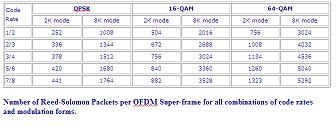
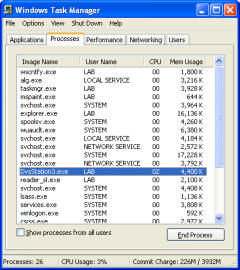
A- Using a similar PC as you are using, we measured the CPU load of Alitronika's DVB-T modulators as follows:
- When the TS is from an external source, via the DVB-ASI or DVB-SPI input => CPU occupancy = 0%
- When the TS is played from the harddisk on the same PC => CPU occupancy = 2% or less.
A- 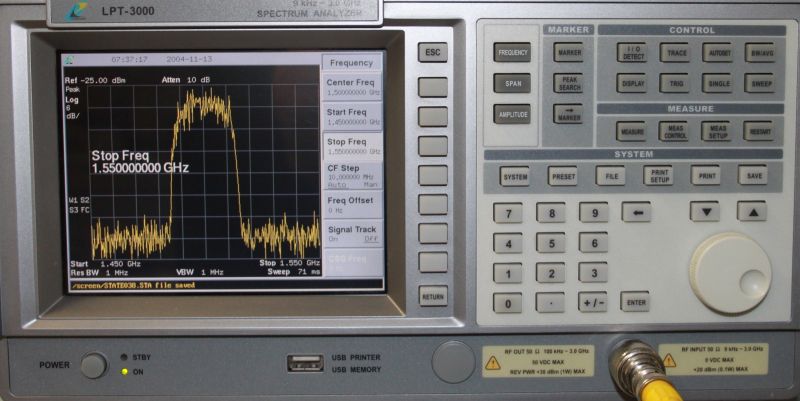
A- The
A-
Our application software, DVSStation2, is FREE
with all our products and you can always download the latest version
from our website. In fact you can download it even if you do not
have any of our products in which case it enters into the demo mode
and you can try it out. You can transmit and receive any Transport
Stream
A- The
latest version of our application software, DVSStation2, has an
integrated Real Time TS Analyser function.
And it is all FREE with every Alitronika's product.
Why pay for the same functions ( OK, with addition of some fancy GUI
! ) when you can get it for free from us.
Q16- Does DVSStation2
support all your products or do we have to buy different
software for each product ?
A-
The DVSStation2 is an integrated Transport Stream Player, Recorder,
Monitor and Real Time Quick TS Analyser. It Supports all our
products. You do not need anything else. It has all the functions
for capturing full transport Streams on your harddisk and playing
any TS from your harddisk. It also allows you to select the
Tuner and LNB settings for DVB-S, DVB-T and DVB-C. In addition it
allows you to analyse the TS files during play or record. 
A-
There are a few Visual mpeg analysers around, this is one reason why
we
do not have one of our own. You could try the VISUALmpeg.
It is not hardware dependent, so it works
with devices from all
vendors, and it is probably better and is more cost effective than
some others which only work with the hardware from the same vendor,
so you end up buying their hardware as well. This is how they
describe it on their website :
" VISUALmpeg
is a software tool the user can analyze MPEG Video streams with. It
is a program for windows and needs no special hardware. The
MPEG-Streams have to be on the harddisk. Live-input streams cannot
be analyzed. The user can choose the different information he wants
to get from the MPEG-Video stream. This homepage shows a few
pictures, analyzed by the program."
Q14- We have a
supplier who charges us too much and has not got most of the
products we need. We would like to change our current supplier
and we see Alitronika has all the products we need. How can we
become your distributor ?
A-
You are very much welcome to join us as so many others have already
done. We offer you the best terms and conditions. Our prices are
already much lower and with free application software included with
every products, you have no problems finding buyers. Extra discounts
are considered for support and promotion of our products. Above all
we reward your contribution towards making sure our customers are
fully supported.
Q13- Is there any Decoder function
on your DVB-T/S/C devices?
A- No,
there are no decoders on board these devices.
Q12- Can I store Full
Transport Stream, including the Null packets, on my Harddisk
using Alitronika's DVB-T, DVB-S or DVB-C devices?
A- Yes.
Q11- Can the recorded
Transport Streams be played by other supplier's players like
Tek, Actern, R&S ..... ?
A-
Yes, the recorded file can be played by other TS players.
Q10- Can your
transport stream player playback TS files recorded by
other supplier's devices? What if the TS has errors or does not
start with a 47H ?
A-
Yes, the DVSStation can playback all recorded TS
files, even if there are corrupted packets or they do not start
with a 47H.
Q9- In the
datasheets the clock accuracy of 25ppm is stated. Is there an option
for a more accurate clock ?
A-
Yes you can have a clock as accurate as 1ppm if you
like.
Q8- We buy our
boards from another supplier, but it has not got all the function we
need, the firmware does not allow customisation. Can your boards be
customised ?
A- Yes,
the firmware on our products are not programmed at factory. They are
loaded every time you start your PC. So we can make different
firmware with the functionality you need for you.
Q7- I have some old
equipments which have ECL input & output rather than LVDS. Is
there an option for ECL input and output ?
A- Yes,
you could select the LVDS or ECL options for the parallel
inputs & outputs.
Q6- Has your system got
the capability of adding Time Stamp to each MPEGII packets ?
A- Yes, you can
select " Time Stamping" as an option while recording a
Transport Stream in which case the hardware inserts four bytes of
"time stamp" at the start of each packets. These time
stamp bytes are taken when the byte 11 of the TS arrives at the
receiver input.
Q5- We are looking for a
DVB card to use with Microsoft DirectShow API, does any of you cards
support this API ?
A- Yes,
we have a BDA driver which works with DirectShow.
Q4- We are using the
AT600USB, DVB-S, device to capture the received transport
streams from the Ku band signal, does this device also
work with C band?
A- The
support for C band depends on the dish, the LNB, the
transmission and so on. If the incoming signal ( 4-6 GHz for C band
) is converted to the 950-2150 MHz range of AT600USB and it is DVB
compatible ( and not DSS ) then there is no reason why it does not
work with AT600USB device.
Q3- We are using
AT20USB device together with our MPEG Encoder to provide a function
for recording TS files into the harddisk . Everything
works well. But is there a way to start and stop the recording
without using the start & stop buttons on DVSStaion?
A- Yes,
the DVSStaion automatically stops recording when there is no
incoming data ( Transport Streams ) and starts again when there
is data. So if your encoder is not sending any Transport stream out
the recording stops. Please remember for the recording option select
"Mbytes" rather than the recording time.
Q2- Do your DVB-T devices have capability
of receiving the 7MHz bandwidth Digital RF signal in Australia ?
A- Yes,
AT800PCI, AT800USB and AT80USB all support 7MHz and 8MHz
bandwidth.
Q1- Could
you outline some of the functions of AT400PCI device ?
- Record Transport streams from any DVB-ASI or
DVB-SPI on your harddisk.
- Play any transport stream files from your
harddisk via DVB-ASI / DVB-SPI.
- Record SMPTE ( SDI ) or Play SMPTE
( SDI ) signals.
- Using Loopthrough & passthrough functions, use
it as 1 to 3 signal router.
- Convert Serial ( ASI ) into Parallel (
SPI )
- Convert Parallel ( SPI ) into ( ASI )
- Convert LVDS/ECL level
signals into LVTTL/LVCMOS levels
- Convert LVTTL/LVCMOS
level signals into LVDS/ECL levels
|
|||||||||||||||||||||||||||||||||||||||||||||||||||||||||||||||||||||||||||||||||||||||||||||||||||||||||||||||||||||||||||||||||||||||||||||||||||||||||||||||||||||||||||||||||||||||||||||||||||||||||||||||||||||||||||||||||||||||||||||
How the several DVB sub-standards interact is described in the DVB Cookbook (DVB-Cook). DVB-S2 is being introduced now in Europe. Since November 2005, two transponders on Astra at 19.2°E send in DVB-S2. DirecTV is also introducing it in the U.S., although its original system was Digital Satellite System (DSS), which uses MPEG-2 but with a different transport stream.
The following characteristics have been devised for the T2 standard:
Comparison of available modes in DVB-T and DVB-T2:
For instance, a UK MFN DVB-T profile (64-QAM, 2k mode, coding rate 2/3, guard interval 1/32) and a DVB-T2 equivalent (256-QAM, 32k, coding rate 3/5, guard interval 1/128) allows for an increase in bit rate from 24.13 Mbit/s to 35.4 Mbit/s (+46.5%). Another example, for an Italian SFN DVB-T profile (64-QAM, 8k, coding rate 2/3, guard interval 1/4) and a DVB-T2 equivalent (256-QAM, 32k, coding rate 3/5, guard interval 1/16), achieves an increase in bit rate from 19.91 Mbit/s to 33.3 Mbit/s (+67%). Status of the DVB-T2 specificationThe DVB-T2 draft standard ratified by the DVB Steering Board on June 26, 2008, and published on the DVB homepage as DVB-T2 standard BlueBook, has been handed over to the European Telecommunications Standards Institute by DVB.ORG on June 20, 2008. The ETSI process resulted in the DVB-T2 standard being adopted on September 9th, 2009.. The ETSI process had several phases, but the only changes were text clarifications.DVB-T2 modulators are on the market and receiver chips are under development. Prototype receivers were shown in September IBC 2008 and more recent version at the IBC 2009 in Amsterdam. A number of other manufacturers are demonstrating DVB-T2 at IBC 2009 including Albis Technologies, Arqiva, Enensys, Harris, Pace, Rohde & Schwarz, Tandberg, and TeamCast according to BroadbandTVNews.com. It reports that other manufacturers planning DVB-T2 equipment launches include Alitronika, CellMetric, Cisco, Digital TV Labs, Humax, NXP Semiconductors, Panasonic, ProTelevision Technologies, Screen Service, SIDSA, Sony, ST Microelectronics and T-VIPS. Since the DVB-T2 physical layer specification is complete, and there will be no further technical enhancements, receiver VLSI chip design has been started with confidence in stability of specification. A draft PSI/SI (program and system information) specification document has been agreed with the DVB-TM-GBS group.
MPEG-2 includes a Systems part (part 1) that defines two distinct (but related) container formats. One is Transport Stream, which is designed to carry digital video and audio over somewhat-unreliable media. MPEG-2 Transport Stream is commonly used in broadcast applications, such as ATSC and DVB. MPEG-2 Systems also defines Program Stream, a container format that is designed for reasonably reliable media such as disks. MPEG-2 Program Stream is used in the DVD and SVCD standards. The Video part (part 2) of MPEG-2 is similar to MPEG-1, but also provides support for interlaced video (the format used by analog broadcast TV systems). MPEG-2 video is not optimized for low bit-rates (less than 1 Mbit/s), but outperforms MPEG-1 at 3 Mbit/s and above. All standards-conforming MPEG-2 Video decoders are fully capable of playing back MPEG-1 Video streams. With some enhancements, MPEG-2 Video and Systems are also used in most HDTV transmission systems. The MPEG-2 Audio part (defined in Part 3 of the standard), enhances MPEG-1's audio by allowing the coding of audio programs with more than two channels. Part 3 of the standard allows this to be done in a backwards compatible way, allowing MPEG-1 audio decoders to decode the two main stereo components of the presentation. Part 7 of the MPEG-2 standard specifies a rather different, non-backwards-compatible audio format. Part 7 is referred to as MPEG-2 AAC. While AAC is more efficient than the previous MPEG audio standards, it is much more complex to implement, and somewhat more powerful hardware is needed for encoding and decoding.
These standards are used for transmission of uncompressed, unencrypted digital television signals (optionally including audio) within television facilities; they can also be used for packetized data. They are designed for operation over short distances; due to their high bitrates they are inappropriate for long-distance transmission. SDI and HD-SDI are currently only available in professional video equipment; various licensing agreements, restricting the use of unencrypted digital interfaces to professional equipment, prohibit their use in consumer equipment. (There are various mod kits for existing DVD players and other devices, which allow a user to add a serial digital interface to these devices).
The PCI bus is common in modern PCs, where it has displaced ISA and VESA Local Bus as the standard expansion bus, but it also appears in many other computer types. The bus will eventually be succeeded by PCI Express and other technologies, which have already started to appear in new computers. The PCI specification covers the physical size of the bus
(including wire spacing), electrical characteristics, bus
timing, and protocols. The specification can be purchased from
the PCI
Special Interest Group (PCISIG).
Applications using BDA drivers: Windows XP Media Center Edition, MediaPortal, GB-PVR The low common-mode voltage (the average of the voltages on the two wires) of about 1.25 V allows LVDS to be used with a wide range of integrated circuits with power supply voltages down to 2.5 V or lower. The low differential voltage, about 350 mV as stated above, causes LVDS to consume very little power compared to other systems. For example, the static power dissipation in the LVDS load resistor is 1.2 mW, compared to the 90 mW dissipated by the load resistor for an RS-422 signal. This power efficiency is maintained at high frequencies because of the low voltage swing. While often referred to as "speed", bitrate does not measure distance/time but quantity/time, and thus should be distinguished from the "propagation speed" (which depends on the transmission medium and has the usual physical meaning). The term baud rate is synonymous with symbol rate, but is less frequently used today as it has in the past been commonly misused to mean bit rate or data rate. The main idea behind OFDM is that since low-rate modulations (i.e modulations with relatively long symbols compared to the channel time characteristics) are less sensitive to multipath, it should be better to send a number of low rate streams in parallel than sending one high rate waveform. This is exactly what OFDM is doing. It divides the frequency spectrum in subbands small enough so that the channel effects are constant (flat) over a given subband. Then a "classical" IQ modulation (BPSK, QPSK, M-QAM, etc) is sent over the subband. If designed correctly, all the fast changing effects of the channel (multipath) disappear as they are now occurring during the transmission of a single symbol and are thus treated as flat fading at the received. Classical signal processing such as channel coding, power allocation, adaptive modulation and coding can be applied for a given subband or over the subbands. Multiuser allocation is also possible, either using time, coding or frequency separation of the users. As with all modulation schemes, QAM conveys data by changing some aspect of a carrier signal, or the carrier wave, (usually a sinusoid) in response to a data signal. In the case of QAM, the amplitude of two quadrature waves is changed (modulated or keyed) to represent the data signal. Phase modulation (analogue PM) and phase-shift keying (digital PSK) can be regarded as a special case of QAM, where the amplitude of the modulating signal is constant, with only the phase varying. This can also be extended to frequency modulation (FM) and frequency-shift keying (FSK), as this can be regarded as a special case of phase modulation. Although analogue QAM is possible, this article focuses on digital QAM. Analogue QAM is used in NTSC and PAL television systems, where the I- and Q-signals carry the components of chroma (colour) information. "Compatible QAM" or C-QUAM is used in AM stereo radio to carry the stereo difference information. As for many digital modulation schemes, the constellation diagram is a useful representation and is relied upon in this article. In QAM, the constellation points are usually arranged in a square grid with equal vertical and horizontal spacing, although other configurations are possible (see e.g. Cross-QAM). Since in digital telecommunications the data is usually binary, the number of points in the grid is usually a power of 2 (2,4,8...). Since QAM is usually square, some of these are rare — the most common forms are 16-QAM, 64-QAM, 128-QAM and 256-QAM. By moving to a higher-order constellation, it is possible to transmit more bits per symbol. However, if the mean energy of the constellation is to remain the same (by way of making a fair comparison), the points must be closer together and are thus more susceptible to noise and other corruption; this results in a higher bit error rate and so higher-order QAM can deliver more data less reliably than lower-order QAM. If data-rates beyond those offered by 8-PSK are required, it is more usual to move to QAM since it achieves a greater distance between adjacent points in the I-Q plane by distributing the points more evenly. The complicating factor is that the points are no longer all the same amplitude and so the demodulator must now correctly detect both phase and amplitude, rather than just phase. 64-QAM and 256-QAM are often used in digital cable television and cable modem applications. In the US, 64-QAM and 256-QAM are the mandated modulation schemes for digital cable, as standardised by the SCTE in the standard ANSI/SCTE 07 2000. Note that many marketing people will refer to these as QAM-64 and QAM-256. In the UK, 16-QAM and 64-QAM are currently used for digital terrestrial television (Freeview and Top Up TV). Although QPSK can be viewed as a quaternary modulation, it is easier to see it as two independently modulated quadrature carriers. With this interpretation, the even (or odd) bits are used to modulate the in-phase component of the carrier, while the odd (or even) bits are used to modulate the quadrature-phase component of the carrier. BPSK is used on both carriers and they can be independently demodulated. Any digital modulation scheme uses a finite number of distinct signals to represent digital data. In the case of PSK, a finite number of phases are used. Each of these phases is assigned a unique pattern of binary bits. Usually, each phase encodes an equal number of bits. Each pattern of bits forms the symbol that is represented by the particular phase. The demodulator, which is designed specifically for the symbol-set used by the modulator, determines the phase of the received signal and maps it back to the symbol it represents, thus recovering the original data. This requires the receiver to be able to compare the phase of the received signal to a reference signal — such a system is termed coherent. Alternatively, instead of using the bit patterns to set the phase of the wave, it can instead be used to change it by a specified amount. The demodulator then determines the changes in the phase of the received signal rather than the phase itself. Since this scheme depends on the difference between successive phases, it is termed differential phase-shift keying (DPSK). DPSK can be significantly simpler to implement than ordinary PSK since there is no need for the demodulator to have a copy of the reference signal to determine the exact phase of the received signal (it is a non-coherent scheme). In exchange, it produces more erroneous demodulations. The exact requirements of the particular scenario under consideration determine which scheme is used. Evolution of mobile TV standardRequirementsSeveral requirements of the new standard were fixed right from the beginning:
ProposalsTen systems from different companies were proposed, and two remaining systems were presented with transmitter and receiver prototypes:
To find the best solution, the Advanced Television Systems Committee assigned the Open Mobile Video Coalition (OMVC) to test both systems. The test report was presented on May 15, 2008. As a result of this detailed work by the OMVC, a final standard draft was designed by the Advanced Television Systems Committee, specialist group S-4. ATSC-M/H will be a hybrid. Basically the following components of the proposed systems are used:
Candidate standardOn December 1, 2008, the Advanced Television Systems Committee elevated its specification for Mobile Digital Television to Candidate Standard status. In the following six months, the industry will test the standard with their potential customers and start first product developments. Before it becomes an official standard, additional improvements will be proposed. ATSC members approved the ratified A/153 standard in October 2009. 1- Multiplexing of the data and to minimize the size of buffers (reduce cost) in receivers. 2- Error detection and control. An elementary stream contains only one kind of data, for example audio or video. The output of a video encoder is an elementary stream. The output of an audio encoder is also an elementary stream. Sometimes referred to as "elementary", "data", "audio", or "video" bitstreams or streams. The format of the elementary stream depends upon the codec or data carried in the stream. ISDB is maintained by the Japanese organisation ARIB. The standards can be obtained for free at the Japanese organization DiBEG website and at ARIB. The core standards of ISDB are ISDB-S (satellite television), ISDB-T(terrestrial), ISDB-C (cable) and 2.6GHz band mobile broadcasting which are all based on MPEG-2 video and audio coding as well as the transport stream described by the MPEG-2 standard, and are capable of high definition television (HDTV). ISDB-T and ISDB-Tsb are for mobile reception in TV bands. 1seg is the name of an ISDB-T service for reception on cell phones, laptop computers and vehicles. The concept was named for its similarity to ISDN, because both allow multiple channels of data to be transmitted together (a process called multiplexing). This is also much like another digital radio system, Eureka 147, which calls each group of stations on a transmitter an ensemble; this is very much like the multi-channel digital TV standard DVB-T. ISDB-T operates on unused TV channels, an approach taken by other countries for TV but never before for radio. Video and audio compressionISDB has adopted the MPEG-2 video and audio compression system. ATSC and DVB also adopted the same system. DVB and ISDB also provide for other video compression methods to be used, including JPEG and MPEG-4, although JPEG is only a required part of the MHEG standard. TransmissionThe various flavors of ISDB differ mainly in the modulations used, due to the requirements of different frequency bands. The 12 GHz band ISDB-S uses PSK modulation, 2.6 GHz band digital sound broadcasting uses CDM and ISDB-T (in VHF and/or UHF band) uses COFDM with PSK/QAM. InteractionBesides audio and video transmission, ISDB also defines data connections (Data broadcasting) with the internet as a return channel over several media (10Base-T/100Base-T, Telephone line modem, Mobile phone, Wireless LAN (IEEE 802.11) etc.) and with different protocols. This is used, for example, for interactive interfaces like data broadcasting (ARIB STD B-24) and electronic program guides (EPG). Interfaces and EncryptionISDB describes a lot of (network) interfaces, but most importantly the Common Interface for Conditional Access (ARIB STD-B25) with the Common Scrambling Algorithm (Multi-2) required for (de-)scrambling TV. The ISDB CAS system is operated by a company named B-CAS in Japan; the CAS card is called B-CAS card. The Japanese ISDB signal is always encrypted by the B-CAS system even if it is a free TV program. That is why it is commonly called "Pay per view system without charge". An interface for mobile reception is under consideration. ISDB supports RMP (Rights management and protection). Since all DTV systems carry digital data content, a DVD or HD recorder could easily copy content losslessly, so that a great deal of pirated content could be circulating the market. Hollywood requested copy protection; this was the main reason for RMP. The content has three modes: “Copy once”, “Copy free” and “Copy never”. In “Copy once” mode a program can be stored on a hard disc recorder, but cannot be copied. ReceiverThere are two types of ISDB receiver: TV and STB (Set top box). The aspect ratio of ISDB television is 16:9; televisions fulfilling these specs are called Hi-vision TVs. There are three TV types: CRT (Cathode ray tube), PDP (Plasma display panel) and LCD (Liquid crystal display), with LCD being the most popular Hi-Vision format on the Japanese market right now. LCD share as measured by JEITA in November 2004 was about 60%. While PDP set occupies the high end market with units that are over 50 inches (1270 mm), PDP and CRT set shares are about 20% each. CRT set are considered low end for Hi-Vision. STB is sometimes referred to as digital tuner. High-end ISDB STB have several interfaces:
ProblemsThough ISDB is a feature-rich system, many problems have surfaced recently. Copy Protection TechnologyAlmost every TV broadcast (including free TV) are encrypted with "Copy-Once", which allows users to record to a digital media (D-VHS, DVD, HDD, etc) but does not allow dubbing to another digital media. On the other hand, the "Copy-Once" technology does not prohibit all types of dubbing. It is possible to dub to an analog media (such as standard VHS) and if recorded to an HDD, it will allow users to "Move" the contents to a D-VHS, but not copy. Many users are also very worried about the recent news of severe protection in the future. There are modes in ISDB to now allow the output of signal from an Analog connector (D-connector, Component, Composite, S-Video, etc). There are already plans to not allow analog output for "Copyright Protection" reasons. (Same as Blu-ray and HD-DVD) This will make all currently sold STB Tuners, and the majority of LCD/Plasma TVs without HDMI inputs unusable. Plus all analog VHS, D-VHS that can only record via analog input, and all DVD players will also become unusable. These more limiting copy protection technologies will all start after analog broadcasting ends (when there won't be any choice for viewers). Currently, no financial assistance schemes have been announced, and viewers without proper devices will be forced to buy a new compatible TV or set top box in order to view ISDB broadcasts. Though not clear, it is said that there are also plans to protect all programs with "Copy-Never". B-CAS CardThe B-CAS card is required to decode all broadcasts. These cards are included with every digital TV or Tuner at no charge. To use this card, you must agree to the statement written on the registration card. Despite the fact that the card must be inserted to watch TV, if you don't agree to the statement, then the user cannot watch digital broadcasts. Essentially, users are "forced" to agree with the statement. Though registration is not required, it is recommended to fully enjoy interactive programs. However, many viewers worry about the leaking of personal information, and the power/rights the TV stations have to access personal information for almost every citizen in Japan. Services
ISDB-SHistoryJapan started digital broadcasting using the DVB-S standard by PerfecTV in October/1996, and DirecTV in December/1997, with communication satellites. Still, DVB-S did not satisfy the requirements of Japanese broadcasters, such as NHK, key commercial broadcasting stations like Nippon Television, TBS, Fuji Television, tv asahi, TV Tokyo, and WOWOW (Movie-only Pay-TV broadcasting). Consequently, ARIB developed the ISDB-S standards. The requirements were HDTV capability, interactive services, network access and effective frequency utilization, and other technical requirements. The DVB-S standard allows the transmission of a bit stream of roughly 34 Mbit/s with a satellite transponder, which means the transponder can send one HDTV channel. Unfortunately, the NHK broadcasting satellite had only four vacant transponders, which led ARIB and NHK to develop ISDB-S: The new standard could transmit at 51 Mbit/s with a single transponder, which means that ISDB-S is 1.5 times more efficient than DVB-S and that one transponder can transmit two HDTV channels, along with other independent audio and data. Digital satellite broadcasting (BS digital) was started by NHK and followed commercial broadcasting stations on 1 December 2000. Today, SKY PerfecTV!, successor of Skyport TV, and Sky D, CS burn, Platone, EP, DirecTV, J Sky B, and PerfecTV!, adopted the ISDB-S system for use on the 110 degree (east longitude) wide-band communication satellite. Technical specificationSummary of ISDB-S (Satellite digital broadcasting)
ChannelFrequency and channel specification of Japanese Satellites using ISDB-S
ISDB-THistoryHDTV was invented at NHK STRL. The research of HDTV started as early as in the 1960s, though only in 1973 a standard was proposed to the ITU-R (CCIR). In the 1980's, the television camera, high definition cathode-ray tube, video tape recorder and editing equipment among others were developed. In 1982 NHK developed MUSE (Multiple sub-nyquist sampling Encoding), the first HDTV video compression and transmission system. MUSE adopted digital video compression system, but for transmission frequency modulation had been adopted after a digital-to-analog converter converted the digital signal. In 1987, NHK made demonstration of MUSE in the Washington D.C and NAB. The demonstration made great impression on the U.S. As a result of this, the U.S. developed ATSC, a terrestrial digital DTV system. Europe also developed their own DTV system, DVB. Although the DVB-T service started operating a few weeks later than the ATSC system, it quickly outstripped ATSC in terms of user base. Japan started R&D of a completely digital system in the 1980s that led to ISDB. Japan started terrestrial digital broadcasting using ISDB-T standard by NHK and commercial broadcasting stations on the 1 December 2003. FeatureISDB-T is characterized by the following features:
AdoptionISDB-T was adopted in commercial transmissions in Japan in December 2003. It comprises a market of about 100 million television sets. ISDB-T had 10 million subscribers by the end of April 2005. Along with the wide use of ISDB-T, the price of STB is getting low. The price of ISDB-T STB in lower end of the market is ¥19800 that is worth $169 at 19 April 2006. (Japanese) uniden Brazil*, which currently uses an analogue TV system (PAL-M) that slightly differs from any other country's, has chosen ISDB-T for its DTV format, calling it SBTVD-T Sistema Brasileiro de Televisão Digital- Terrestre. Other than that, there are no other countries that are considering ISDB. Possibly because ISDB Tuners and TVs are way too expensive compared to other formats. However, it does seem to have an advantage over ATSC and DVB-T in reception tests. The ABERT/SET group in Brazil did system comparison tests of DTV under the supervision of the CPqD foundation. The comparison tests were done under the direction of a work group of SET (the Brazilian Television Engineering Society) and ABERT (the Brazilian Association of Radio and Television Broadcasters). The ABERT/SET group selected ISDB-T as the best in the digital broadcasting systems among ATSC, DVB-T and ISDB-T. ISDB-T was pointed out as the most flexible of all for better answering the necessities of mobility and portability. It is most efficient for mobile and portable reception. In June 29, 2006, Brazil announced ISDB as the chosen standard for Digital TV transmissions, to be fully implemented until 2016. See SBTVD.
Technical specificationSegment struture ARIB has developed the segment structure called OFDM (see figure). ISDB-T divides the frequency band of one channel into thirteen segments. Broadcaster can select the combination of segments to use: this choice of segment structure allows for flexibility of services. For example, ISDB-T can transmit a LDTV and a HDTV using one TV channel or change to 3 SDTV, a switch that can be performed anytime. ISDB-T can also change the modulation scheme at the same time.
Summary of ISDB-T
ChannelSpecification of Japanese terrestrial digital broadcasting using ISDB-T
2.6 GHz Mobile satellite digital audio/video broadcastingMobaHo! is the name of the services that uses the Mobile satellite digital audio broadcasting specifications. MobaHo! started its service on 20th October, 2004. ISDB-TsbISDB-Tsb is the terrestrial digital sound broadcasting specification. The technical specification is the same as ISDB-T. ISDB-Tsb supports the coded transmission of OFDM siginals. ISDB-CISDB-C is cable digital broadcasting specification. The technical specification is developed by JCTEA. StandardsARIB and JCTEA developed the following standards. Some part of standards are located on the pages of ITU-R and ITU-T.
Table of terrestrial HDTV transmission systems
|
|||||||||||||||||||||||||||||||||||||||||||||||||||||||||||||||||||||||||||||||||||||||||||||||||||||||||||||||||||||||||||||||||||||||||||||||||||||||||||||||||||||||||||||||||||||||||||||||||||||||||||||||||||||||||||||||||||||||||||||
ARIB Technical Reports (published in June, 2007)
ISDB-T (Integrated Service Digital Broadcasting - Terrestrial) has been
developed and now on service in Japan, and adopted by Brazil.
ISDB-T proves best performances in Japanese DTTB service for more than 3
years.
Since Dec. 2003, start of Japanese DTTB service, DTTB service is rapidly
migrated because of its advantages, and new service, named
"One-seg", portable reception service in same channel, has been
started from April 2006.
But, because of late start of ISDB-T, ISDB-T is not so popular in the world,
so, we will submit this technical report to South America countries to
understand the ISDB-T system and its advantages on technical aspect.
Now, 3 major DTTB( Digital Terrestrial TV Broadcasting) systems exist.
These are called:| 1- ATSC: Advanced Television System Committee, Developed in USA, and now used. | |
| 2- DVB-T: Digital Video Broadcasting – Terrestrial, developed in EU, and now used. | |
| 1- ISDB-T: Integrated Service Digital Broadcasting – Terrestrial, developed in Japan and now used in Japan and Brazil. |
| 1- structure of technical standard for digital broadcasting | |
| Generally speaking, Digital broadcasting system is composed by 3 functional blocks, (1)Source coding block, (2)Multiplex block, and (3)transmission coding block. | |
| 2- About ISDB-T transmission system | |
| Japanese digital terrestrial broadcasting system adopts excellent technologies for transmission system. | |
| 3- Outline of transmission parameter | |
| ISDB-T transmission system has a flexibility for the purpose of broadcasting service. |
ARIB Standards for Digital Terrestrial TV Broadcasting
For the details of structure of technical standard and relationship between each standards, see "Structure of Japan's digital broadcasting"
|
|||
|
A/D - Analog/Digital A/V - Audio/Video AAC - Advanced Audio Coding AAL - ATM Adapter Layer ABR - Available Bit Rate AC - Alternating Current ADC- Analog to Digital Converter ADD/DROP-MUX - Add and Drop Multiplexer ADPCM - Adaptive Differential Pulse Code Modulation ADR - Astra Digital Radio ADSL - Asymmetric Digital Subscriber Line AES - Audio Engineering Society AF - Adaptation Field AF - Audio Frequency AFC - Automatic Frequency Control AGC - Automatic Gain Control AGDT - Additional Guide Data Table AGL - Above Ground Level AM - Amplitude Modulation ANSI - American National Standards Institute API - Application Programming Interface APS - Antenna Positioning System AR - Activity Ratio ASCII - American Standard Code for Information Interchange ASI - Asynchronous Serial Interface ASIC - Application Specific Integrated Circuit ASK - Amplitude Shift Keying ATM - Asynchronous Transfer Mode ATSC - Advanced Television Systems Committee ATSC-MPG - ATSC-Master Guide Table ATV - Advanced Television B-frame - Bi-directional prediction frame BAN - Broadband Access Network BAP - Body Animation Parameters BAT - Bouquet Association Table BCD - Binary Coded Decimal BDP - Body Definition Parameters BER - Bit Error Rate BERT - Bit Error Rate Test BNC - Bayonet-Neill-Concelman (connector) BOM - Begin of Message BP - Band-Pass BPSK - Binary Phase Shift Keying BRA - Basic Rate Access BRR - Bit Rate Reduction BSAC - Bit-Sliced Arithmetic Coding BTA - Broadcasting Technology Association BW - Bandwidth C/I - Carrier to Interference Ratio C/N - Carrier to Noise Ratio CA - Conditional Access CAM - Conditional Access Module CAS - Conditional Access System CAT - Conditional Access Table CATV - Community Antenna Television (Cable Television) CCD - Charge Coupled Device CCIR - Comité Consultatif International des Radiocommunications (French, since 1993: ITU-R) CCIR - Consultative Committee for International Radiocommunications CCITT - Comité Consultatif International Téléphonique et Télégraphique (French, since 1993: ITU-R) CD - Compact Disc CDA - Confidential Disclosure Agreement CD-DA - Compact Disc - Digital Audio CD-I - Compact Disc - Interactive CDMA - Code Division Multiple Access CD-ROM - Compact Disc - Read Only Memory CE - Core Experiment CEC - Commission of the European Community CEI - Commission Electrotechnique Internationale CELP - Code Excited Linear Prediction CEMA - Consumer Electronics Manufacturers Association CEN - Comité Européen de Normalisation CENELEC - Comité Européen de Normalisation Electrotechnique CEPT - Conférence Européenne des Administrations des Postes et des Télécommunications (French), European Conference of Postal and Telecommunications Administrations CI - Common Interface CIF - Common Intermediate Format CIT - Channel Information Table CLK - Clock CLUT - Colour Look-Up Tables CMIP - Common Management Information Protocol CMOS - Complementary Metal Oxide Semiconductor CNR - Carrier to Noise Ratio = C/N CODEC -Coder-Decoder COFDM - Coded Orthogonal Frequency Division Multiplexing CPB - Constrained Parameter Bitstream CPE - Customer Premises Equipment CPS - Constrained Parameter Set CPU - Central Processing Unit CRC - Cyclic Redundance Check CRT - Cathode Ray Tube CSA - Common Scrambling Algorithm CTB - Composite Triple Beat CW - Control Word D/I - Drop and Insert DAB - Digital Audio Broadcasting DAC - Digital to Analog Converter DAI - DMIF-Application Interface DAPSK - Differential Amplitude Phase Shift Keying DAVIC - Digital Audio-Visual Council dB - Decibel DBS - Direct Broadcast Satellite DC - Direct Current DCC - Digital Communications Channel DCC - Digital Compact Cassette DCE - Data Communication Equipment DCO - Digital Controlled Oscillator DCT - Discrete Cosine Transform DDR - Digital Disk Recorder DDS - Digital Data Service DECT - Digital Enhanced Cordless Telecommunications DEMOD - Demodulator DEMUX - Demultiplexer DFD - Displayed Frame Difference DIP - Descriptive Information Parcel DIS - Draft International Standard DIT - Discontinuity Information Table DMA - Direct Memory Access DMIF - Delivery Multimedia Integration Framework DNI - DMIF Network Interface DNS - Domain Name Server DPCM - Differential Pulse Code Modulation DPSK - Differential Phase Shift Keying DRAM - Dynamic Random Access Memory DRO - Dielectric Resonator Oscillator DS - DMIF signalling DSBSC - Double Sideband Suppressed Carrier DSC - Digital Serial Components DSM-CC - Digital Storage Media - Command and Control DSNG - Digital Satellite News Gathering DSP - Digital Signal Processor DSR - Digital Satellite Radio DSS - Digital Satellite System DTA - Data Terminal Access DTC - Data Transmission Code DTE - Data Terminal Equipment DTH - Direct to Home (Satellite reception) DTS - Decoding Time Stamp DTTB - Digital Terrestrial Television Broadcasting DTTV - Digital Terrestrial Television DTTV-SA - Digital Terrestrial Television - Systems Aspects DTV - Digital Television DVB - Digital Video Broadcasting DVB-ASI - Digital Video Broadcasting - Asynchronous Serial Interface DVB-C - DVB-Cable DVB-CA - DVB-Conditional Access DVB-CS - DVB-Cable Satellite Master Antenna Television Distribution System DVB-Data - DVB-Data Broadcasting DVB-LVDS - Digital Video Broadcasting - Low Voltage Differential Signalling DVB-MC - DVB-Microwave Cable Based DVB-MG - DVB-Measurement Group DVB-MS - DVB-Microwave Satellite Based DVB-PI - DVB-Physical Interface Group DVB-RCC - DVB-Return Channel Cable DVB-S - Digital Video Broadcasting - Satellite DVB-SI - Digital Video Broadcasting - Service Information DVB-T - Digital Video Broadcasting - Terrestrial DVC - Digital Video Cassette DVD - Digital Video Disc DVI - Digital Video Interactive EACEM - European Association of Consumer Electronics Manufacturers EAV - End of Active Video EBU - European Broadcasting Union(UER, French) ECL - Emitter Coupled Logic ECM - Entitlement Control Message EDTV - Enhanced Definition Television EEPROM - Electrically Erasable Programmable Read Only Memory EHF - Extremely High Frequency EIRP - Effective Isotropic Radiated Power EIT - Event Information Table EMM - Entitlements Management Message EN - European Norms EOM - End OF Message EPG - Electronic Program Guide ERC - European Regulatory Committee ERO - European Radio Communications Office ES - Elementary Stream ESA - European Space Agency ETR - ETSI Telecommunication Report ETS - European Telecommunication Standard ETSI - European Telecommunications Standards Institute EVM - Error Vector Magnitude EX-OR - Exclusive Order (XOR) F/D - Focal Distance to Diameter Ratio FAP - Facial Animation Parameters FAQ - Frequently Asked Questions FBA - Facial and Body Animation FCAPS - Faults, Configuration, Accounting, Performance and Security management FCC - Federal Communications Commission FDDI - Fiber Distributed Data Interface FDM - Frequency Division Multiplex FDMA - Frequency Division Multiple Access FDP - Facial Definition Parameters FEC - Forward Error Correction FFT - Fast Fourier Transform FM - Frequency Modulation FPGA - Field Programmable Gate Arrays FSK - Frequency Shift Keying FSS - Fixed Satellite Service FTP - File Transfer Protocol FTTB - Fibre To The Building FTTC - Fibre To The Curb FTTH - Fibre To The Home G/T - Gain over Noise Temperature Gb/s - Gigabits per Second GDMO - Guidelines for the Definition of Managed Objects GFC - Generic Flow Control GHz - Gigahertz GIF - Graphics Interchange Format GMT - Greenwich Mean Time GOP - Group of Pictures GPS - Global Positioning System GSM - Global System for Mobile Communications GSO - Geo-Synchronous Orbit GSTN - General Switched Telephone Network HAN - Home Access Network HDCL - High-speed Data link Channel HDD - Hard Disk Drive HD-MAC - High Definition Multiplexed Analogue Components HDSL - High-speed Digital Subscriber Line HDTV - High Definition Television HEC - Headed Error Control HEX - Hexadecimal HFC - Hybrid Fibre Coax HILN - Harmonic Individual Line and Noise HLN - Home Local Network HP - Horizontal Polarization HPA - High Power Amplifier HTML - HyperText Mark-up Language HTTP - HyperText Transfer Protocol HVXC - Harmonic Vector Excitation Coding I-frame - Intra-coded frame I/O - Input/Output I/Q - In/Quadratur-Phase IBO - Input Backoff IC - Integrated Circuit ICTSB - Information and Communication Technology Standards Board ID - Identification, Identifier IDCT - Inverse Discrete Cosine Transform IDFT - Inverse Discrete Fourier Transform IEC - International Electrotechnical Committee IEEE - Institute of Electrical and Electronic Engineers IETF - Internet Engineering Task Force IF - Intermediate Frequency IMUX - Input Multiplexer IP - Internet Protocol IPI - Intellectual Property Identification IPP - Internet Presence Provider IPPV - Impulse Pay per View IPR - Intellectual Property Rights IR - Infra Red IRD - Integrated Receiver Decoder IRE - Institute of Radio Engineers IS - International Standard ISA - Industry Standard Architecture ISDB-T - Integrated Services Digital Broadcasting-Terrestrial ISDN - Integrated Services Digital Network ISI - Inter-Symbol Interference ISL - Intersatellite Link ISO - International Standards Organization ISP - Internet Service Provider ITFS - Instructional Television Fixed Service ITU - International Telecommunications Union(UIT, French) ITU-R - International Telecommunications Union -Radiocommunication ITU-T - International Telecommunications Union -Telecommunication ITU-TS - International Telecommunications Union-Telecommunication Standardisation Sector JPEG - Joint Photographic Experts Group JTC - Joint Technical Committee kb/s - Kilobits per second kHz - Kilohertz KLT - Karhunen-Loeve Transform LAN - Local Area Network LAR - Logarithmic Area Ratio LC - Low Complexity LCD - Liquid Crystal Display LDTV - Low Definition Television LED - Light Emitting Diode LMDS - Local Multipoint Distribution System LNA - Low Noise Amplifier LNB - Low Noise Block LO - Local Oscillator LOS - Line of Sight LP - Low Power LPC - Linear Predictive Coding LSB - Least Significant Bit LSP - Line Spectral Pairs LTP - Long Term Prediction LVDS - Low Voltage Differential Signaling MAC - Media Access Control MAC - Multiplexed Analog Components MATV - Master Antenna Television Mb/s - Megabits per second MBPS - Megabits per second MBU - Multiple Business Unit MC - Multichannel (MPEG-2 Audio) MCNS - Multimedia Cable Network Systems MCPC - Multi Channel per Carrier MCS - Multipoint Communications System MCU - Multipoint Control Unit MDCT - Modified Discrete Cosine Transform MDS - Multipoint Distribution Service MFN - Multiple Frequencies Network MHEG - Multimedia and Hypermedia Expert Group MHP - Multimedia Home Platform MHz - Megahertz MIB - Management Information Base MIDI - Musical Instrument Digital Interface MIME - Multipurpose Internet Mail Extensions MIPS - Mega/Million Instructions Per Second M-JPEG - Motion-JPEG (Joint Photographic Experts Group) MMDS - Multichannel Microwave Distribution System MMDS - Multichannel Multipoint Distribution System MMI - Man-Machine-Interface MODEM - Modulator/Demodulator MOPS - Mega/Million Operations Per Second MP@ML - Main Profile at Main Level MPEG - Moving Picture Experts Group MPEG-J - Framework for MPEG Java API’s MPG - Master Guide Table MPTS - Multiple Programs Transport Stream MR - Multi-Resolution MR-QAM - Multi-Resolution QAM MSB - Most Significant Bit MSDL - MPEG 4 Systems and Description Language MSO - Multi-System Operator MTBF - Mean Time Between Failures MTS - Multiple Transport Stream MUSE - Multiple-Subsampling-Encoding MUSICAM - Masking Pattern Adapted Universal Subband Integrated Coding and Multiplexing MUX - Multiplexer MVDS - Multipoint Video Distribution System (40 GHz Band) MVPD - Multichannel Video Programming Distributor NA - Network Adapter NAB - National Association of Broadcasters NBC - Non-Backwards Compatible Audio (MPEG-2 Audio) NHK - Nippon Hoso Kyokai, Japanese broadcaster NIC - Network Information Centre NIT - Network Information Table NM - Network Management NMF - Network Management Forum NNI - Network Network Interface NRZ - Non-Return-to-Zero NTSC - National Television System Committee NVOD - Near Video On Demand OBO - Output Backoff OCAM - Open Conditional Access Module OD - Object descriptor OFDM - Orthogonal Frequency Division Multiplex OFS - Operational Fixed Service OMT - Rumbaugh Object Modeling Technique OMUX - Output Multiplexer OSD - On Screen Display OSI - Open Systems Interconnection P-frame - Predicted frame PAL - Phase Alternating Line PALplus - Advanced PAL PAT - Program Association Table PC - Personal Computer PCI - Program Controlled Interrupt PCM - Pulse Code Modulation PCMCIA - Personal Computer Memory Card International Association PCR - Program Clock Reference PD - Phase Discriminator PDH - Plesiochronous Digital Hierarchy PDM - Pulse Duration Modulation PDU - Protocol Data Unit PES - Packetized Elementary Stream PH - PES Header PI - Professional Interface PID - Packet Identifier PIN - Personal Identification Number PIP - Privat Information Parcel PL - Payload PLL - Phase Locked Loop PMT - Program Map Table POP - Point of Presence POTS - Plain Old Telephone Service PPP - Point to Point Protocol PPV - Pay per View PRA - Primary Rate Access PRBS - Pseudo-Random Binary Sequences PS - Program Stream PSD - Power Spectral Density PSI - Program Specific Information PSK - Phase Shift Keying PSNR - Peak Signal to Noise Ratio PSS - Procedures, Specifications, Standards PSTN - Public Switched Telephone Network PTI - Payload Type Indicator PTS - Presentation Time Stamp PTT - Post, Telegraph and Telephone PVRG - Portable Video Research Group QAM - Quadrature Amplitude Modulation QCIF - Quarter Common source Intermediate Format QEF - Quasi Error-Free QOS - Quality of Service QPSK - Quadrature Phase Shift Keying RAID - Redundant Array of Independent Disks RAM - Random Access Memory RC - Remote Control RES - Residential RF - Radio Frequency RFI - Radio Frequency Interference RFP - Request for Proposal RFP - Request for Proposal RGB - Red Green Blue RJ - Registered Jack (connector) RLC - Run Length Coding RMA - Random Multiple Access ROM - Read Only Memory RPC - Remote Procedure calls RS - Reed-Solomon (-Code) RSA - Response Service Area RSH - Response Station Hub RST - Running Status Table RTSP - Real Time Streaming Protocol RTTP - Real Time Transport Protocol S/N - Signal to Noise Ratio SAAL - Signaling ATM Adaption Layer SAR - Successive Approximation Register SAS - Subscriber Authorization System SAV - Start of Active Video SAW - Surface Acoustic Wave (Filter) SB - Steering Board SC - Subcommittee SCPC - Single Channel per Carrier SCR - System Clock Reference SCSI - Small Computer Standard Interface SDH - Synchronous Digital Hierarchy SDI - Serial Digital Interface SDS - Satellite Digital Systems SDT - Service Description Table SDTV - Standard Definition Television SECAM - Séquentielle à Mémoire(French), Sequential with memory(television) SER - Symbol Error Rate SFN - Single Frequency Network SGML - Standard Graphical Mark-up Language SI - Service Information SIF - Source Input Format SIMD - Single Instruction Multiple Data SIMS - Service Information Management System SIT - Service Information Table SL - Synchronization Layer SLA - Service Level Agreement SLM - Signal Level Meter SMATV - Satellite Master Antenna Television SMPTE - Society of Motion Picture and Television Engineers SMS - Subscriber Management System SNA - System Network Architecture SNG - Satellite News Gathering SNHC - Synthetic Natural Hybrid Coding SNMP - Simple Network Management Protocol SNR - Signal to Noise Ratio (= S/N) SOD - Service on Demand SOHO - Small Office, Home Office SONET - Synchronous Optical Network SPI - Synchronous Parallel Interface SPTS - Single Program Transport Stream SRAM - Static Read Access Memory SS - Solid State SSI - Synchronous Serial Interface SSPA -Solid State Power Amplifier ST - Stuffing Table STB - Set Top Box STC - System Time Clock STL - Studio Transmitter Link STM - Synchronous Transport Module STP - Shielded Twisted Pair SW - Short Wave T/F coder - Time/Frequency Coder TA - Terminal Adapter TCP - Transmission Control Protocol TCP/IP - Transmission Control Protocol / Internet Protocol TDM - Time Division Multiplexing TDMA - Time Division Multiple Access TDT - Time Date Table TI - Terrestrial Interference TIFF - Tagged Image File Format TM - Technical Module( within DVB-Project) TMN - Telecommunications Management Network TOT - Time Offset Table TP - Transport Packet TPO - Transmitter Power Output TPS - Transmission Parameter Signaling TS - Transport Stream TSINP - Transport Stream Input T-STD - Transport Stream System Target Decoder TTL _ Transistor Transistor Logic TTS - Text to Speech TV - Television TVRO - Television Receive Only TWTA - Traveling Wave Tube Amplifier TX - Transmitter UDP - User Datagram Protocol UER - Union Européenne de Radio-Télévision(French) UHF - Ultra High Frequency, 470 - 862 MHz (Television) UIT - Union Internationale des Télécommunications(French) UMTS - Universal Mobile Telecommunication System UPS - Uninterruptable Power Supply URD - User Requirements Document URL - Uniform Resource Locator UTC - Universal Time, Coordinated UTO - Unshielded Twisted Pair VBI - Vertical Blank Interleave VBR - Variable Bit Rate VBV - Video Buffer Verifier (MPEG-2 Video) VC - Virtual Channel VCO - Voltage Controlled Oscillator VCR - Video Cassette Recorder VDSL - Very high-bit rate Digital Subscriber Line VHF - Very High Frequency VHS - Video Home System VLBV - Very Low Bitrate Video VLC - Variable Length Coding VLD - Variable Length Decoder VLSI - Very Large Scale Integration VMS - Virtual Memory System VOD - Video on Demand VP - Vertical Polarization VP - Virtual Path VPI - Virtual Path Indicator VRML - Virtual Reality Modeling Language VSAT - Very Small Aperture Satellite Transmission VSAT - Very Small Aperture Terminal VSB-AM - Vestigial Sideband Amplitude Modulation VS - Voltage Standing WR - Wave Ratio VTO - Voltage Tuned Oscillator VTR - Video Tape Recorder WAN - Wide Area Network WCA - Wireless Cable Association International WCS - Wireless Communication Service WG - Working Group WGDTB - Working Group on Digital Television Broadcasting WLL - Wireless Local Loop WMN - Wireless Multimedia Network WPM - Wireless PC Modem WWW - World Wide Web WYSIWYG - What You See Is What You Get Y - Luminance |
 |
 |



| |
|
 DVB short
for Digital Video Broadcasting, is a suite of
internationally accepted,
DVB short
for Digital Video Broadcasting, is a suite of
internationally accepted,